
Every food blogger I’ve talked to lately is doing the same thing. Traffic is down 40%, 60%, sometimes more. RPMs are in the gutter. And somewhere between the panic and the spreadsheets, they found a solution that sounded almost too good: just use AI to write more content, faster.
I get it. When the algorithm takes your livelihood, you look for the fastest exit. And ChatGPT is right there, offering to write your chicken piccata post in 45 seconds.
Here’s the problem. That 45-second post is exactly what Google is now specifically trained to identify, and bury.

Let’s be clear about what Google actually says, because a lot of people are misreading this.
Google doesn’t ban AI-generated content outright. They’ve said that repeatedly, and it’s true. What Google’s systems seek to reward is helpful, people-first content, and if you use automation, including AI generation, to produce content for the primary purpose of manipulating search rankings, that’s a violation of their spam policies.
Google’s own Search Quality Rater Guidelines make this distinction explicit. The December 2025 Core Update was the first update to specifically target AI content quality: not AI content in general, but AI content that lacks human insight, personal experience, or original thinking. The March 2026 update doubled down: sites using AI to generate topic overviews or generic explanations of well-documented subjects were penalized because that content lacked experience signals, not because an AI produced it.
Read that last part again. Not because an AI produced it. Because it lacked experience signals.
This is the distinction that most food bloggers are missing entirely.
The first E in E-E-A-T, Experience, was added by Google in 2022. It’s the newest signal, and after HCU, it’s arguably the most important one for food bloggers specifically. If you haven’t read our breakdown of the full E-E-A-T framework yet, start there. It’s the foundation of everything in this post.
AI can never demonstrate true experience with anything. At best, it can make assumptions about the human experience, but it won’t be unique. Think about what that means for a recipe post. Google’s quality raters are now explicitly trained to ask: did this person actually cook this dish? Did they burn the first batch? Did they figure out that the dough needs an extra 10 minutes if your kitchen runs cold? Did they photograph it themselves?
A recipe from someone who has made it a dozen times, troubleshot the timing, and photographed the result with their own hands. That’s what Google is trying to surface. A recipe assembled from the top five results by a language model is exactly what Google is trying to bury.
And here’s the thing that nobody is talking about in the food blogging community: your photos are one of the most powerful experience signals you have.
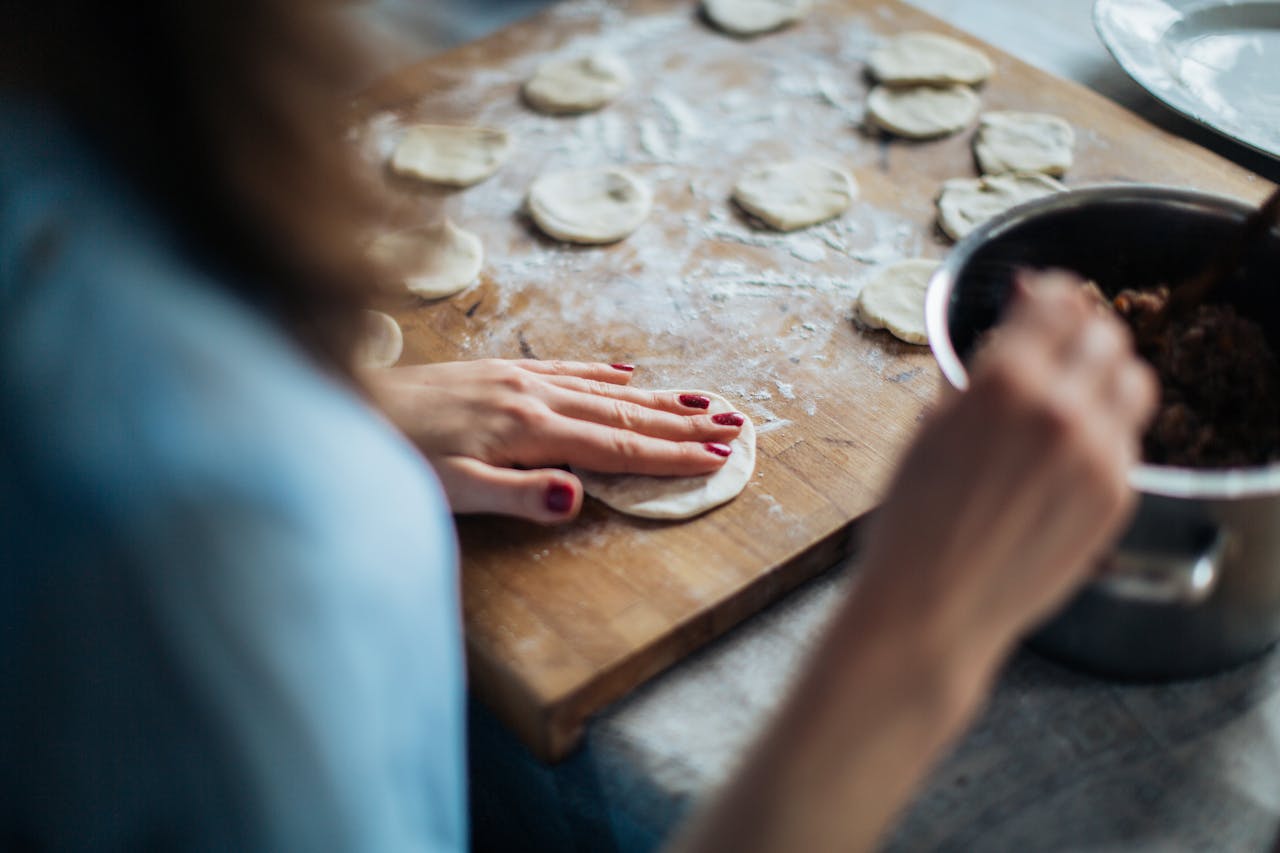
Google’s quality raters use a document called the Search Quality Rater Guidelines to evaluate pages. One of the primary ways they assess Experience is by looking for evidence that the creator was actually there, actually did the thing.
For a recipe blog, the most immediate and undeniable proof of that is the photograph.
A photo taken by someone who cooked the dish looks different from a stock image. It has real steam, real imperfection, a specific light source that matches a real kitchen. The sauce is slightly uneven because someone ladled it by hand. The garnish was placed by someone who actually tasted it and thought this needs parsley. That’s not just aesthetics. That’s evidence.
When a reader lands on your recipe post and sees a photo that looks like you actually made this, in your kitchen, with your hands, they stay. They scroll. They save the recipe. User satisfaction metrics like dwell time and return visits are now weighted more heavily than in previous updates.
When they see a photo that looks like it came from a food styling studio or a slightly off AI-generated image, they bounce. Google notices.
| ⚡ Quick audit: open your last 5 published recipes.Do the photos look like you cooked them in your kitchen?Or do they look like they could belong to any food blog on the internet?That’s the experience gap, and it’s measurable in your bounce rate. |
Here’s what happens when food bloggers go all-in on AI content:
This is the trap. The instinct when traffic drops is to publish more. The counterintuitive reality post-HCU is that publishing less, better, is the only strategy that works.
Five posts that demonstrably come from someone with firsthand kitchen experience will outperform fifty AI-assembled posts every single time in the current algorithm. If you want to understand why the ad-supported content farm model is broken at a structural level, we wrote the full breakdown here.
So what does winning look like in 2026? Based on everything Google has published and what’s actually recovering traffic for food bloggers, it comes down to three things:
1. Demonstrate firsthand experience in every post.
This means process photos that show real cooking stages. It means including the mistake you made the first time. It means your specific tip: not a generic ‘season to taste’ but ‘I found that adding the paprika after you pull it off heat gives it more punch.’ That’s the kind of detail only someone who made the dish can include.
2. Build topical authority, not a content farm.
Google wants to see that your site covers a topic deeply and completely. Six interconnected recipes on pulled pork (the technique, the tacos, the mac and cheese, the sliders, the fried rice, the nachos) sends a stronger authority signal than six unrelated recipes published the same week. This is exactly the strategy behind Content Clusters, and it’s the approach that’s driving real recovery for the bloggers implementing it. It’s also increasingly the only thing that still gets a click at all. Zero-click search is eating single-recipe posts first.
3. Make your visual content work as proof, not decoration.
Your photos are experience signals. A compelling hero shot that looks like it came from a real kitchen, styled by someone who actually ate the dish. That’s not just good Pinterest content. It’s part of how Google evaluates whether you are who you say you are. We go deep on exactly which visual elements matter most in our Image SEO guide for food bloggers.
There’s an irony that doesn’t get discussed enough.
The food bloggers who are recovering traffic after HCU aren’t the ones who found a smarter AI tool or a better prompt. They’re the ones who doubled down on the thing that AI genuinely cannot replicate: proof that a real person was in the kitchen.
Real recipes. Real process. Real photos.
The bloggers who are losing ground are the ones trying to out-produce the algorithm. You cannot out-produce an AI. But you can out-experience it, because experience, genuine, firsthand, messy, imperfect, human experience, is the one thing no language model can generate.
AI-generated content can coexist with strong E-E-A-T when anchored to real experience. Sites that use AI to expand on genuinely experienced content largely maintained or improved rankings. Sites that replaced experience with AI-generated generalities were penalized most severely.
This is documented directly in Google’s March 2025 Core Update documentation and confirmed by the pattern of sites that recovered vs those that didn’t across the following months.
Use AI to format, to outline, to brainstorm. But the experience has to be yours. The recipe has to be tested. The photo has to prove you were there.
ChatGPT isn’t your enemy. It’s a tool that’s being massively misused by people who are scared and looking for a shortcut.
The bloggers who win from here aren’t going to win by using AI better. They’re going to win by investing in the things AI cannot produce: authentic content, tested recipes, and photographs that make readers, and Google, believe that you were standing in that kitchen.
That’s not a technology problem. That’s a strategy problem.
And the strategy is clear: do less, go deeper, and make sure every post you publish proves you were there.


Great taste! Keep these recipes fresh in your cart by entering your email below. We’ll even slip a special code into your inbox to sweeten the deal.